Launch offer — valid today only

The Easiest Way to Review Speech-Language Pathology for Class, Clinic or the Praxis Explained with Drawings, One Topic per Page

The larynx, language milestones, the IPA consonant chart, phonological processes, stuttering, dyslexia, dysphagia and aphasia: in your textbook it's a wall of text. Here every topic fits on one page, with the drawing and what you need to remember. Made for the U.S.: American English IPA, IDEA and Section 504. 62 illustrated pages.

GET THE ILLUSTRATED GUIDE

🔒 Secure checkout · PDF by email · 30-day guarantee

One topic per pagethe drawing shows you how it works and the text walks you through it
62 illustrated pages8 parts, from the speech mechanism to games for home and school
Up-to-date sourcesBased on ASHA's public resources, IDEA, Section 504 and CDC milestones

This Is What the Pages You Will Study Look Like

One topic per page, the drawing that shows you how it works and the boxes with what you need to know:

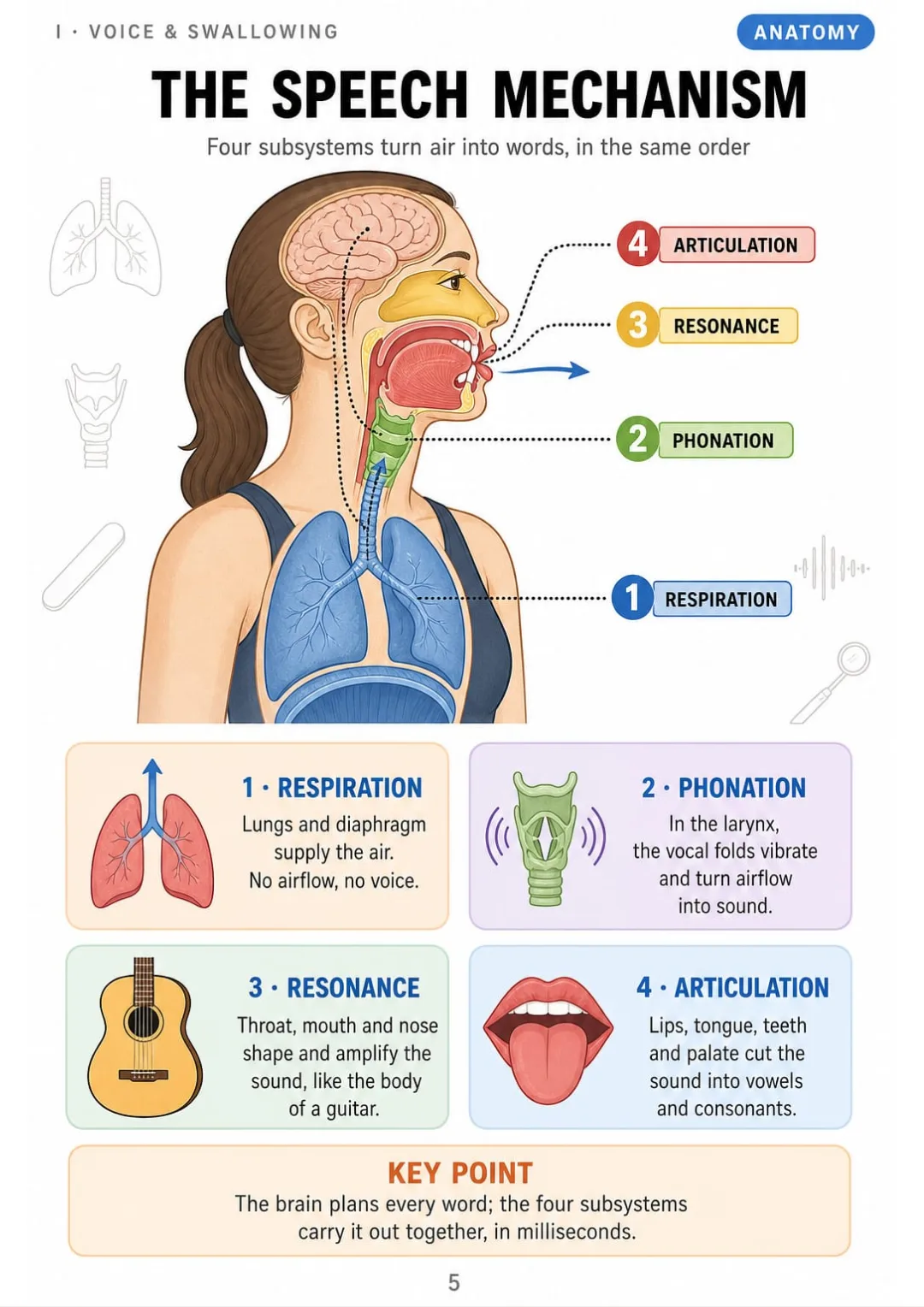
Respiration, phonation, resonance, articulation: the four subsystems of speech in four colors.
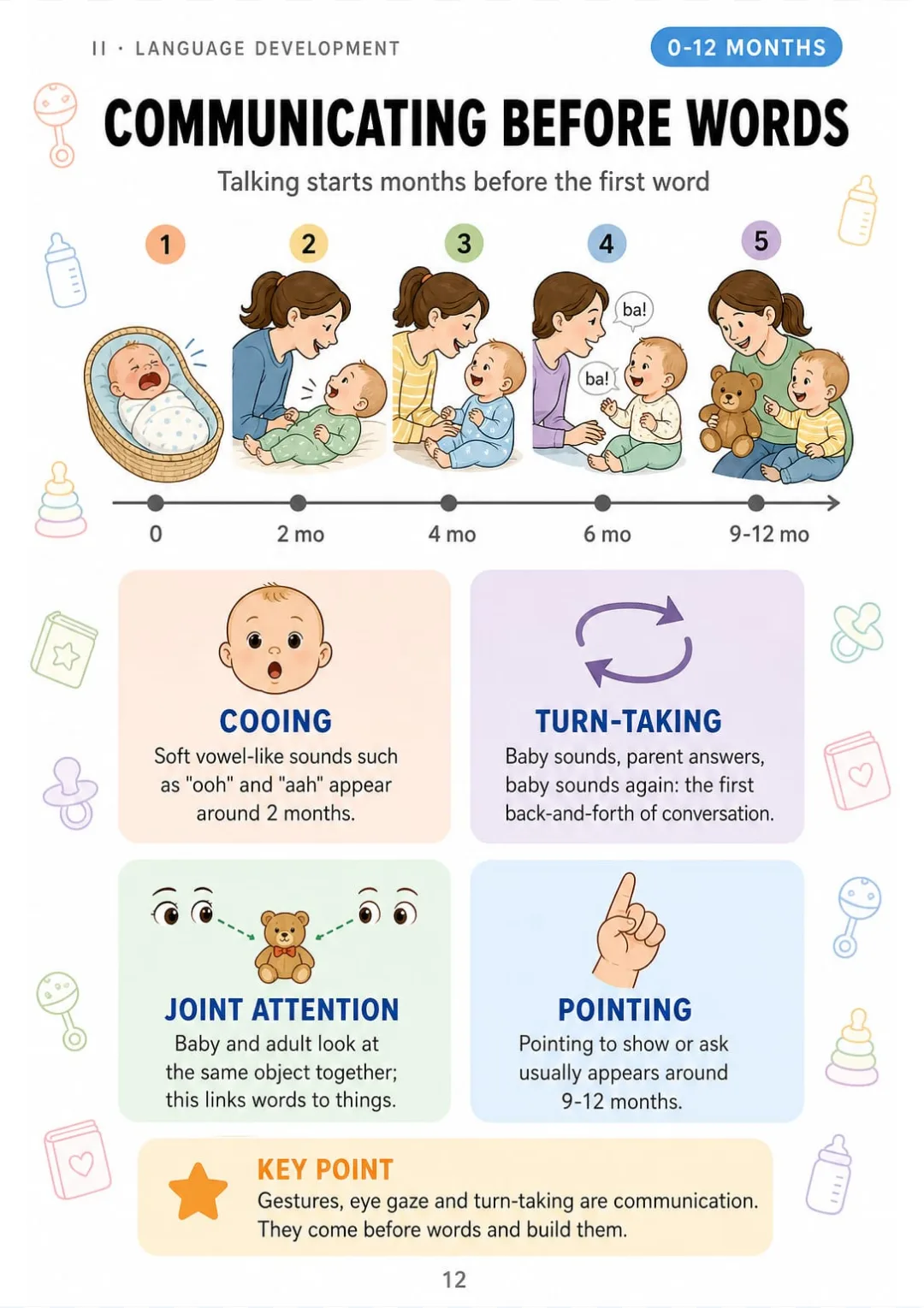
Cooing around 2 months, pointing around 9-12 months: the five stops before the first word.
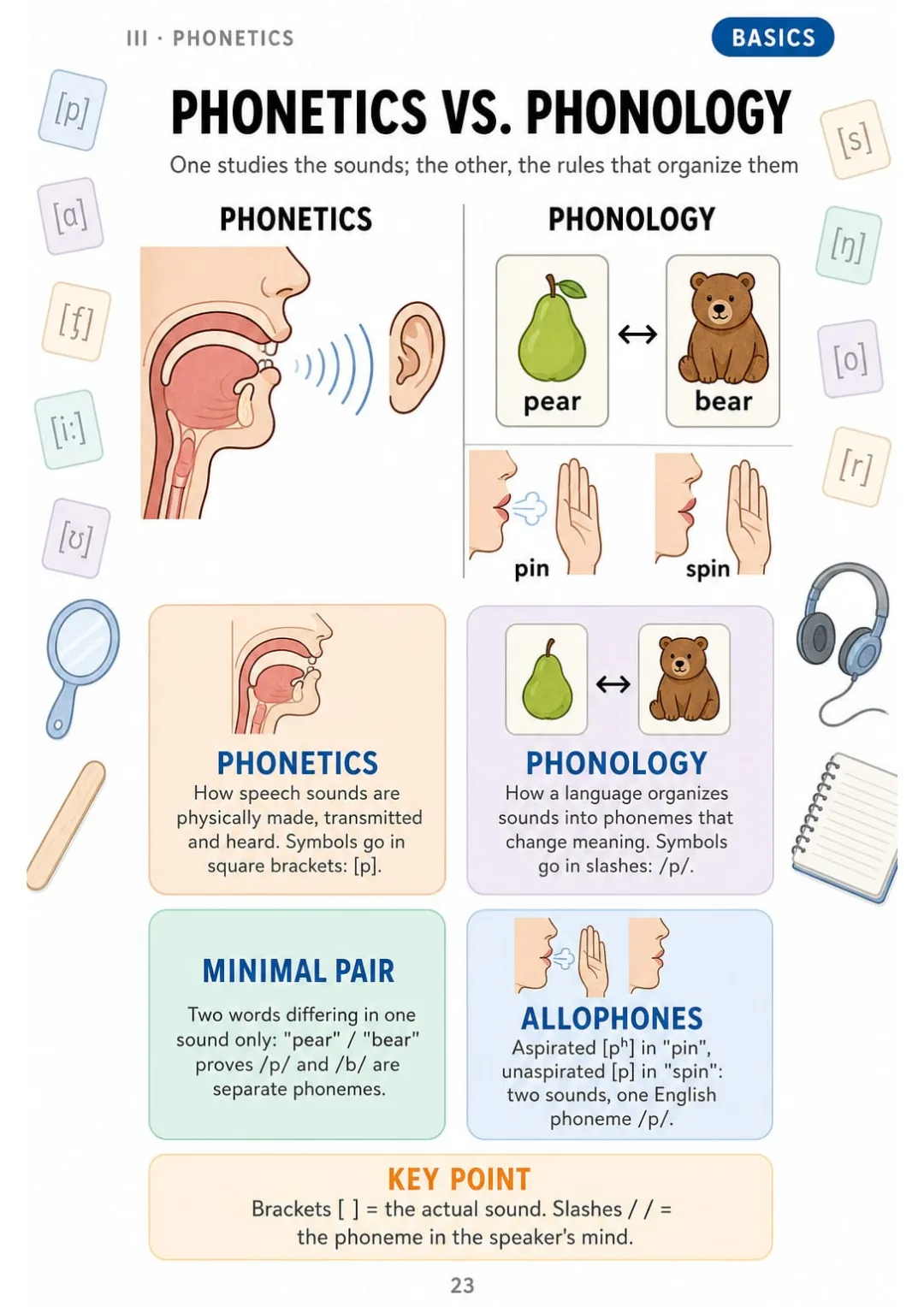
"Pin" vs. "spin": two different [p] sounds, one phoneme /p/
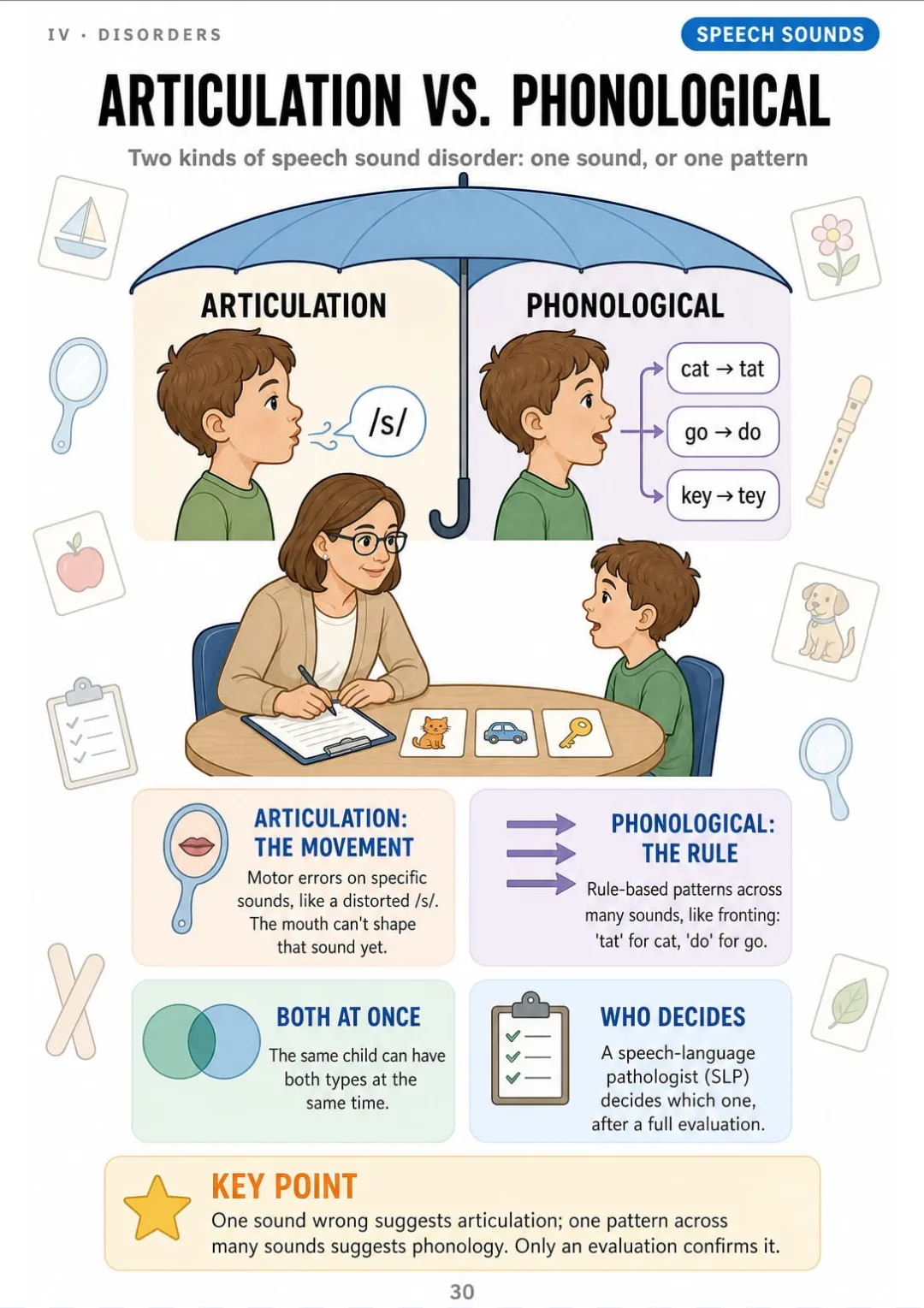
Articulation = motor error on one sound · Phonological = one pattern across many sounds
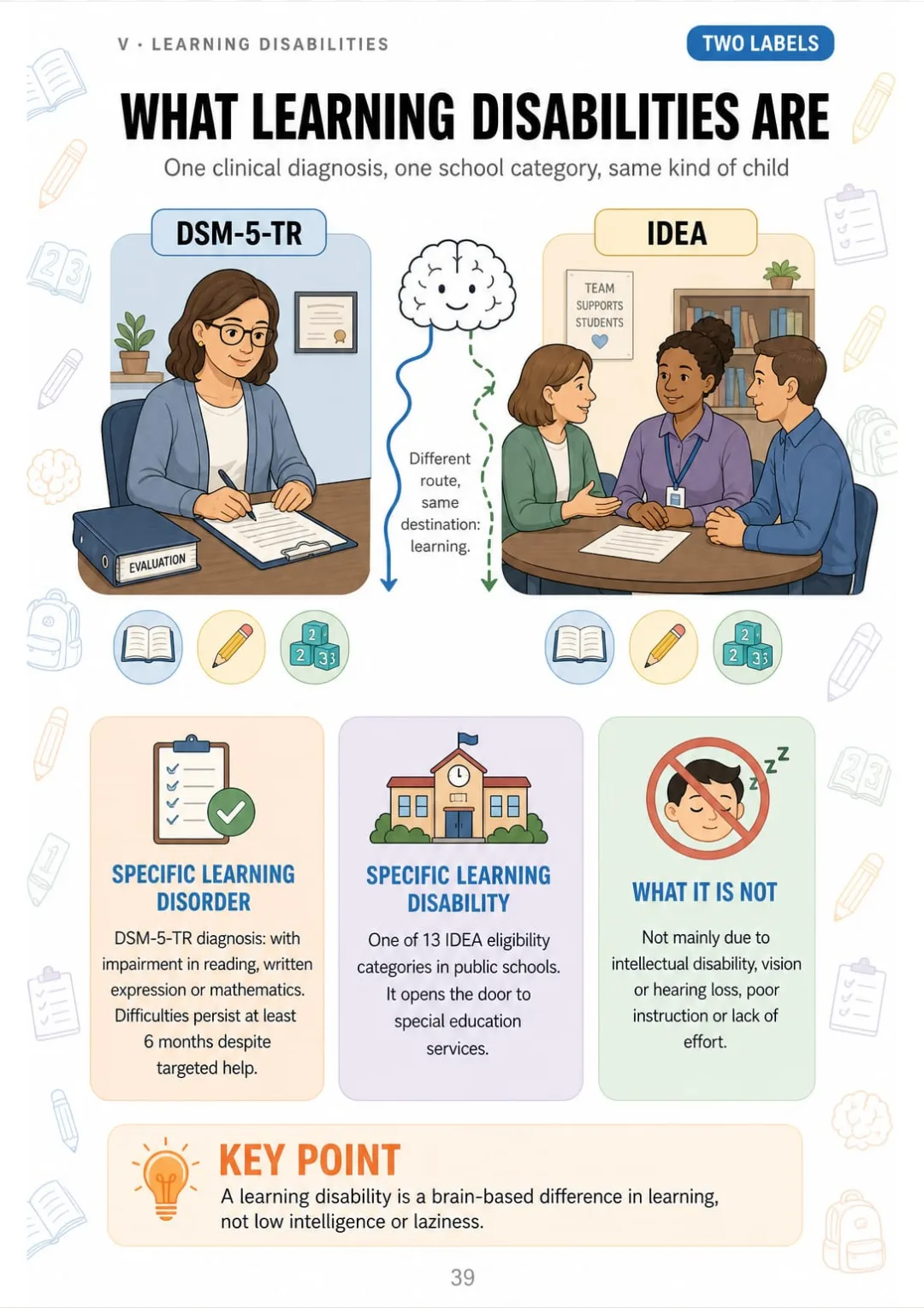
Specific learning disorder (DSM-5-TR) vs. specific learning disability (IDEA), side by side
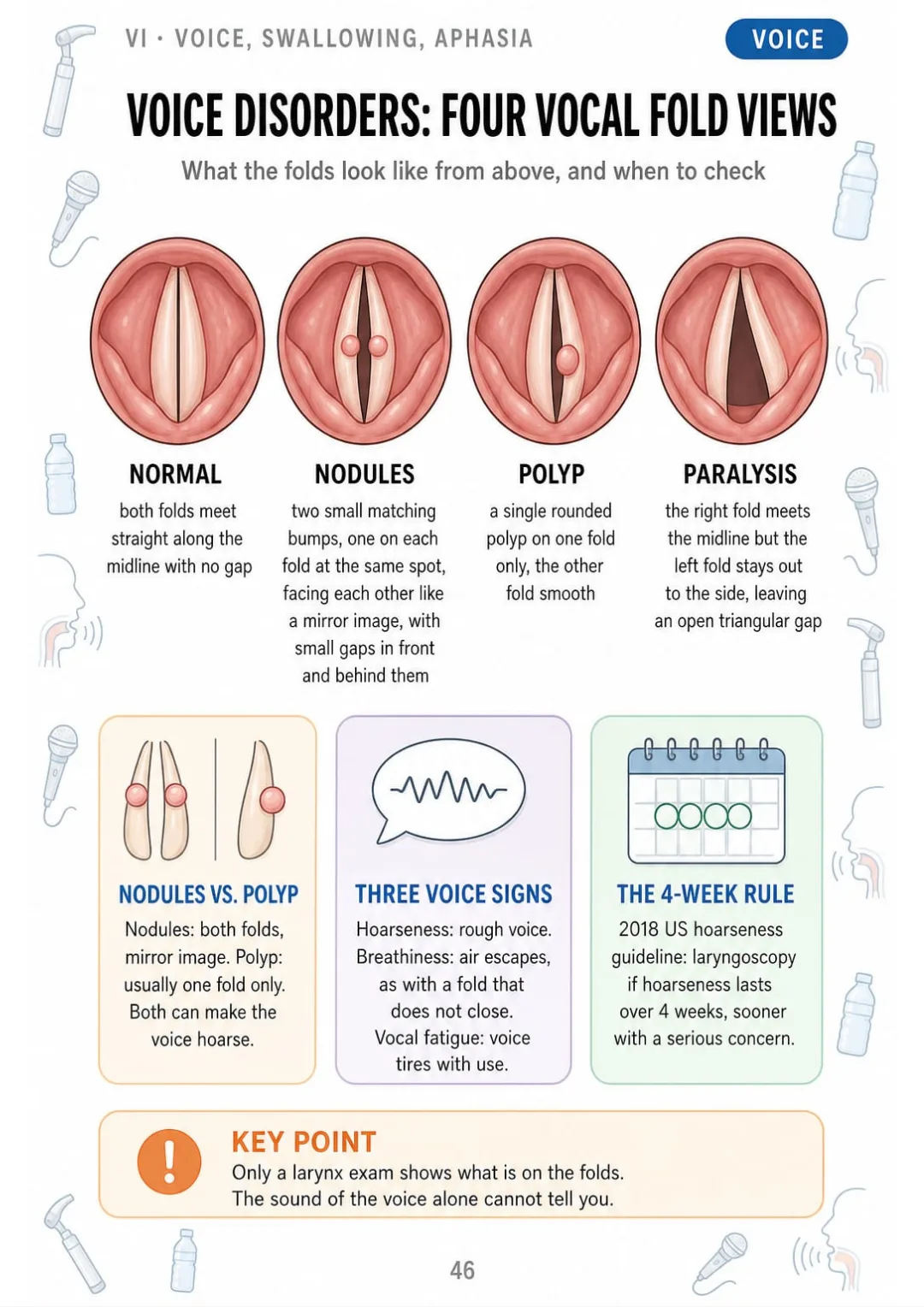
Nodules on both folds, a polyp on one, and a larynx exam after 4 weeks of hoarseness.
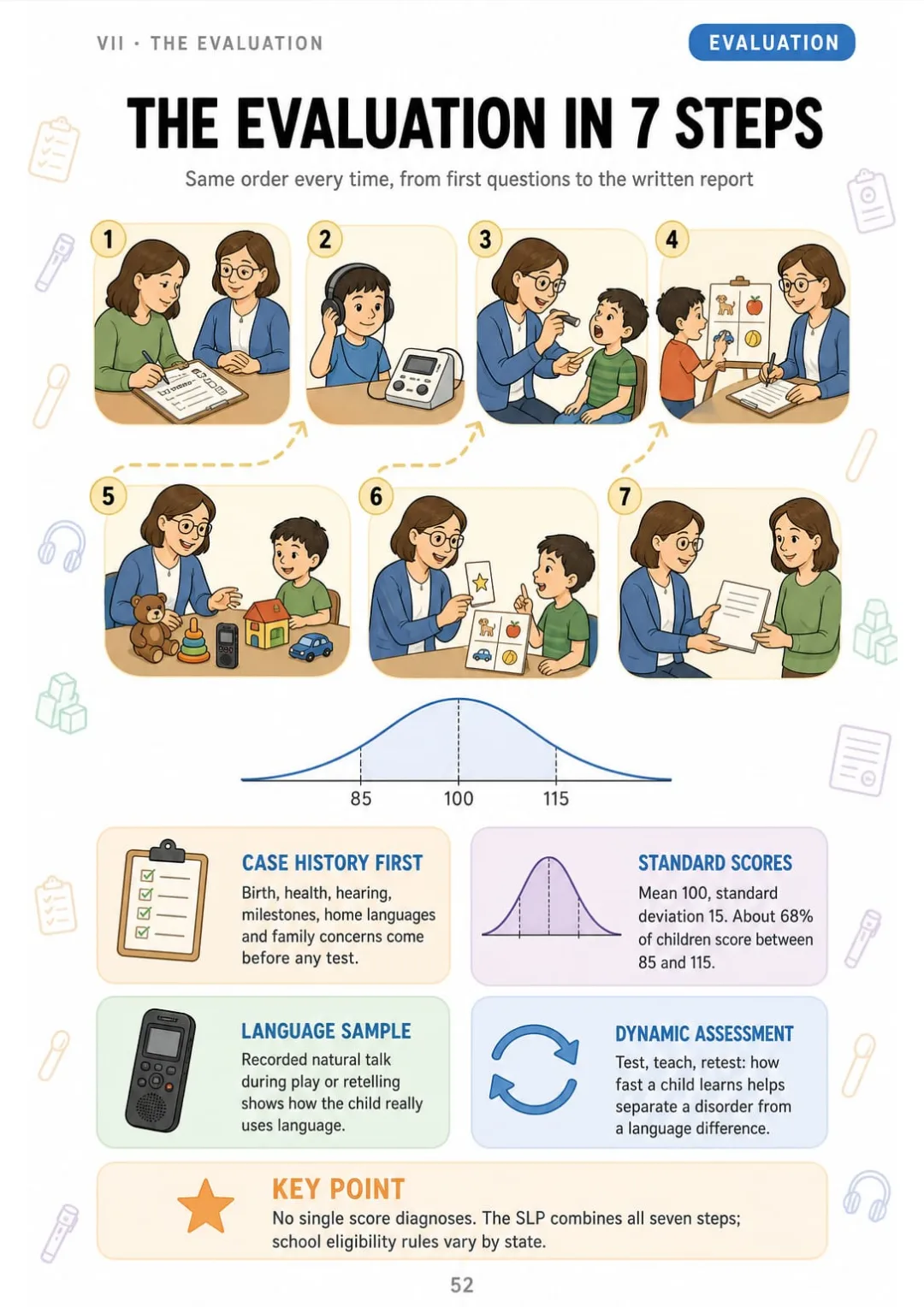
Case history, hearing, oral mechanism, tests (mean 100, SD 15), sample, dynamic assessment, report.
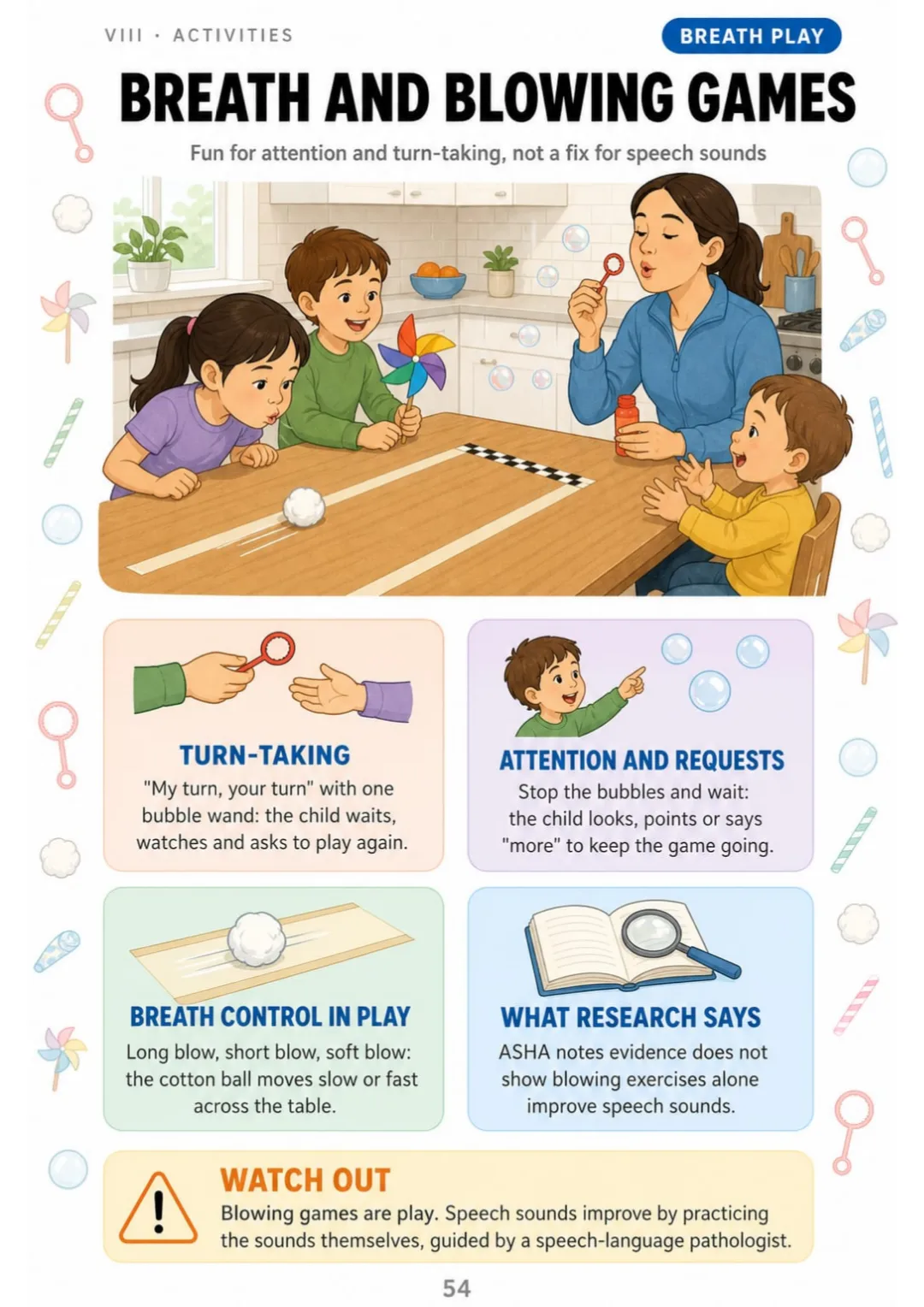
Bubbles, pinwheels and cotton-ball races: what they build and what they don't.

Swipe to see more →

These are real pages from the book. The table of contents is the full one: 8 parts and 58 topics.

It's Not That You Have a Bad Memory. It's That No One Ever Organized It for You.

You've read the difference between phonetics and phonology three times. You close your textbook...

...and you can't tell a sound from a phoneme anymore. It was just one line after another.

"Pin" vs. "spin": two different [p] sounds, one phoneme /p/

Here phonetics vs. phonology is one page: "pin" and "spin" side by side: an aspirated [pʰ] and a plain [p], two sounds, one phoneme /p/.

And on the pages next to it, every topic has its own: places of articulation, manners of articulation, the consonant chart, phonological processes and phonological awareness.

First you understand why it works that way. Then the brackets and the slashes stick on their own.

SEE THE DIFFERENCE

Stop memorizing milestones you can't picture:

THIS
  • Pages and pages of dense text
  • Milestones without a single drawing
  • In the session, you don't know where to start
Prelinguistic communication encompasses the range of preintentional and intentional behaviors through which the infant participates in social exchange prior to the emergence of referential speech. Reflexive vocalizations are followed, at approximately 6 to 8 weeks of age, by cooing, characterized by quasi-resonant vowel-like productions, and subsequently by vocal play, during which the infant explores variations in pitch, loudness and laryngeal control. Joint attention, gaze following and conventional gestures, including showing, giving and pointing, typically consolidate between 9 and 12 months, preceding the first true words.
FOR THIS
  • Every milestone drawn
  • One topic per page, with the rules in boxes
  • You remember it because you've seen it
Cooing around 2 months, pointing around 9-12 months: the five stops before the first word.
CONTENTS

Take a Look at the 8 Parts and 58 Topics

The speech mechanism, language development, phonetics and phonology, speech and language disorders, dyslexia and learning disabilities, voice, swallowing and aphasia, the evaluation, and activities and games: 62 pages, all illustrated

IVoice and Swallowing · pp. 5-11
  1. The speech mechanism
  2. Breathing for speech
  3. The larynx
  4. The vocal folds
  5. The articulators
  6. Swallowing
  7. The ear and hearing
IILanguage Development · pp. 12-22
  1. Communicating before words
  2. Babbling
  3. First words
  4. The vocabulary spurt
  5. Sentences and grammar
  6. Getting ready for school
  7. When to ask for an evaluation
  8. Practice questions 1-5 (Parts I-II)
  9. Practice questions 6-10 (Parts I-II)
  10. Practice questions 11-15 (Parts I-II)
  11. Practice questions 16-20 (Parts I-II)
IIIPhonetics and Phonology · pp. 23-29
  1. Phonetics and phonology
  2. The vowels of American English
  3. Places of articulation
  4. Manners of articulation
  5. The consonant chart
  6. Phonological processes
  7. Phonological awareness
IVSpeech and Language Disorders · pp. 30-38
  1. Articulation and phonological disorders
  2. /r/ and /s/: rhotic errors and lisps
  3. Stuttering
  4. Developmental language disorder
  5. Bilingualism and myths
  6. Practice questions 21-25 (Parts III-IV)
  7. Practice questions 26-30 (Parts III-IV)
  8. Practice questions 31-35 (Parts III-IV)
  9. Practice questions 36-40 (Parts III-IV)
VDyslexia and Learning Disabilities · pp. 39-45
  1. What learning disabilities are
  2. Dyslexia
  3. Dysgraphia
  4. Spelling and written expression
  5. Dyscalculia
  6. IDEA and Section 504
  7. Accommodations and modifications
VIVoice, Swallowing and Aphasia · pp. 46-51
  1. Voice disorders
  2. Vocal hygiene
  3. Dysphagia
  4. Tongue thrust and atypical swallow
  5. Aphasia
  6. Communicating with a person with aphasia
VIIThe Evaluation · pp. 52-53
  1. The speech-language evaluation
  2. The speech-language pathologist
VIIIActivities and Games · pp. 54-62
  1. Breath and blowing games
  2. Mouth movement games
  3. Sound games
  4. Syllable games
  5. Every day at home
  6. Drawn glossary: the body
  7. Drawn glossary: the words
  8. Explained answers
  9. The whole book on one page

What If Every Topic Fit on a Single Page?

Imagine this:

Instead of rereading half a page about places of articulation without being able to picture them...

...you open the page and find a cross-section of the mouth with every American English consonant on the spot where it's made, in IPA.

Specific learning disorder (DSM-5-TR) vs. specific learning disability (IDEA), side by side

And the larynx, language milestones, stuttering, dyslexia and aphasia turn into drawings and charts you can read at a glance.

You stop memorizing and start understanding.

That's exactly what Speech Therapy Made Visual does. It's not "just another textbook." It's 8 parts and 48 illustrated topics, plus 40 practice questions with explained answers and the whole book on one page. Because what your brain sees in order, it remembers.

Because what your brain sees organized, it remembers.

Here Is What You Get with Speech Therapy Made Visual:

Ipp. 5-11

Voice and Swallowing

The speech mechanism, breathing for speech, the larynx and vocal folds, the articulators, swallowing and hearing: you see where every sound starts before you have to name it.

IIpp. 12-22

Language Development

Communicating before words, babbling, first words, the vocabulary spurt, sentences and grammar, getting ready for school, when to ask for an evaluation, and 20 practice questions.

IIIpp. 23-29

Phonetics and Phonology

Phonetics vs. phonology, the vowels of American English, places and manners of articulation, the consonant chart, phonological processes and phonological awareness: brackets, slashes and IPA symbols stop looking like code.

IVpp. 30-38

Speech and Language Disorders

Articulation vs. phonological disorders, /r/ and /s/ errors, stuttering, developmental language disorder, bilingualism myths, and 20 more practice questions.

Vpp. 39-45

Dyslexia and Learning Disabilities

What learning disabilities are, dyslexia, dysgraphia, spelling and written expression, dyscalculia, IDEA and Section 504, and accommodations vs. modifications.

VIpp. 46-51

Voice, Swallowing and Aphasia

Voice disorders and vocal hygiene, dysphagia, tongue thrust, aphasia, and how to communicate with a person with aphasia.

VIIpp. 52-53

The Evaluation

The speech-language evaluation in 7 steps, from case history to the written report, and what an SLP does at each one: you know where to start and what the report means.

VIIIpp. 54-62

Activities and Games

Breath, mouth, sound and syllable games, everyday ideas for home, two drawn glossaries, the explained answers and the whole book on one page.

At the end of the book: 40 practice questions with explained answers and the whole book on one page.
And That Is Not All: 2 More Books, Free

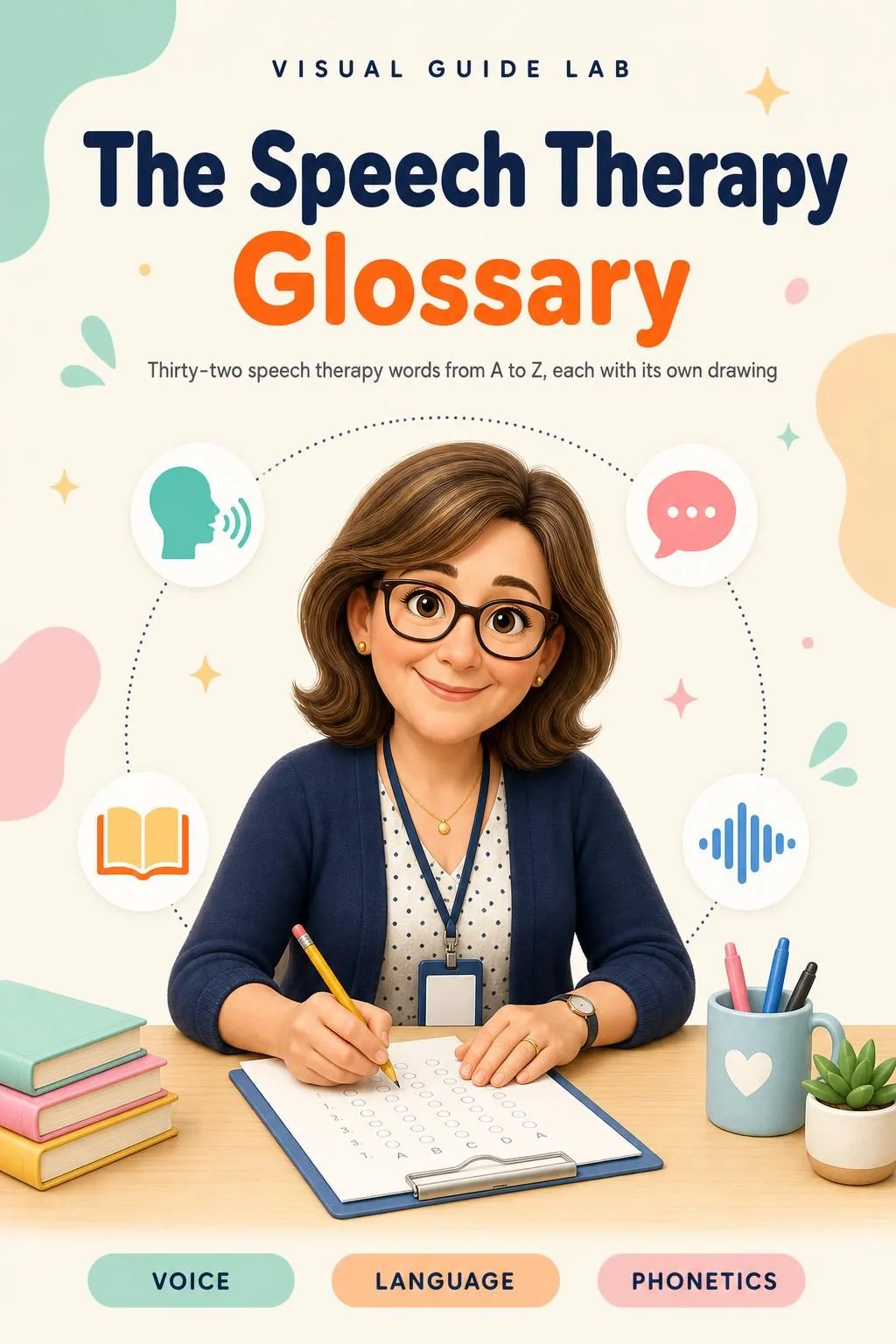
The Speech Therapy Glossary

BONUS 1: «The Speech Therapy Glossary»

Value on its own: US$ 17.90

Thirty-two speech therapy words from A to Z, each with its own drawing: aphasia, case history, minimal pair, dysphagia, phoneme, glottis, babbling, morphosyntax, praxis, lisp and many more.

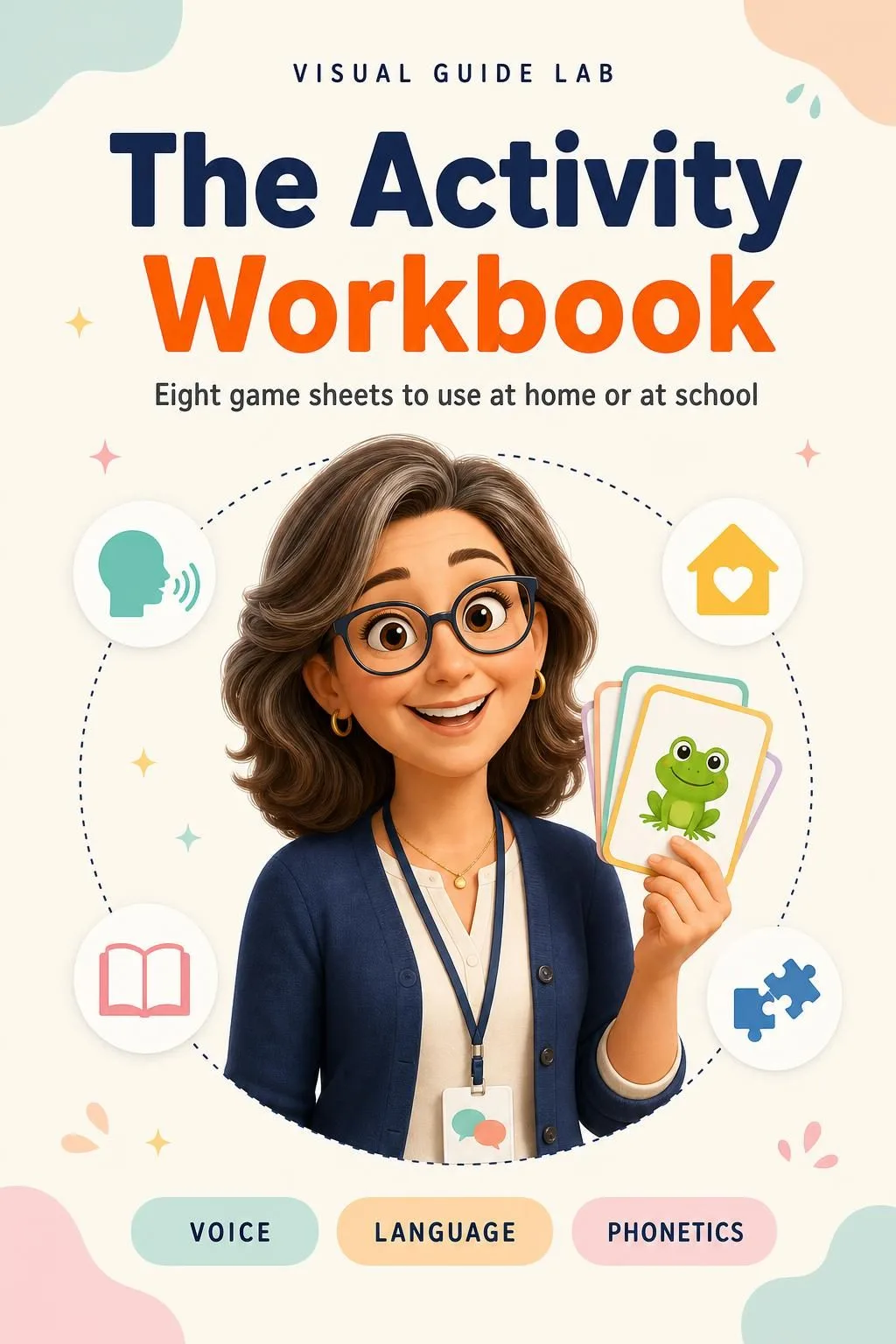
The Activity Workbook

BONUS 2: «The Activity Workbook»

Value on its own: US$ 14.90

Eight game sheets to use at home or at school: breath and blowing, lips, tongue, listening, rhymes, syllables and first sounds, with a sheet to track progress.

Speech Therapy Made Visual + 2 Free Books

  • Speech Therapy Made Visual: 62 illustrated pagesUS$ 63
  • BONUS 1: The Speech Therapy GlossaryUS$ 17.90
  • BONUS 2: The Activity WorkbookUS$ 14.90
  • High-resolution PDF to printIncluded
Total value US$ 95.80
YOUR PRICE:
US$ 27
You save US$ 68.80
YES, I WANT SPEECH THERAPY MADE VISUAL FOR US$ 27

📄 This is a digital PDF book sent to your email: nothing is printed or shipped.

Secure purchaseEncrypted payment30-day guarantee

PDF by email: Speech Therapy Made Visual reaches your inbox as a PDF, and the two free books come by email too. One-time payment, no installments or hidden costs.

Is This Book for You?

You're in a CSD program or reviewing for the Praxis

You're in a CSD program or reviewing for the Praxis

Anatomy, milestones, phonetics and disorders, one topic per page, to review between classes and clinic hours. Plus 40 practice questions with explained answers.

You work as an SLPA or you're coming back to the field

You work as an SLPA or you're coming back to the field

A quick visual review of what comes up in sessions: the consonant chart, phonological processes, stuttering and the evaluation in 7 steps.

You're a teacher, a para or a parent

You're a teacher, a para or a parent

The terms you hear in IEP meetings and evaluation reports, each on one drawn page, plus sound and syllable games for class or home.

To Sum Up: Here Is What You Get

US$ 95.80US$ 27
YES, I WANT SPEECH THERAPY MADE VISUAL FOR US$ 27

📄 This is a digital PDF book sent to your email: nothing is printed or shipped.

30DAYS
GUARANTEE

30-Day Guarantee

30-day guarantee: tell us what didn't work and we'll refund 100%.

You have 30 days to try Speech Therapy Made Visual and the two bonus books. If it doesn't work for you, tell us what didn't work and we'll refund 100% of what you paid. One-time payment, no subscription.

Frequently Asked Questions

How do I get the material?

After your purchase you'll get an email with Speech Therapy Made Visual as a high-resolution PDF, to read on your phone or print. The two bonus books come by email too: The Speech Therapy Glossary, 32 key terms, each with its drawing, for quick review before a session; and The Activity Workbook, 8 printable sound and syllable game sheets for class or home.

Is it a monthly or a one-time payment?

A single one-time payment. No installments and no subscription.

Who is it for?

For speech-language pathology students, for SLPAs and SLPs who want a visual review, and for teachers, paras and parents who want to understand speech and language. If you already work as an SLPA or you've finished your degree, it won't make you start from scratch: it organizes what you already know, one page per topic, so you can check it fast before a session. See the table of contents above for every topic.

What sources is it based on?

On ASHA's Practice Portal and public resources, IDEA (34 CFR Part 300) and Section 504 (34 CFR Part 104), DSM-5-TR criteria for specific learning disorder, the International Dyslexia Association definition, the IDDSI framework, CDC developmental milestones and the 2018 AAO-HNS guideline on hoarseness. Sounds are in the IPA of American English.

Is it official material?

No. It's an independent study guide. It isn't published, endorsed or reviewed by ASHA, ETS, the U.S. Department of Education or any school district, and it doesn't come with a certificate or ASHA CEUs.

Does it replace my program or my training?

No. It's a visual review that puts your textbooks and coursework in order. It doesn't replace your CSD program, clinical supervision, or an evaluation by a certified speech-language pathologist or a doctor.

Are the practice questions the ones on the exam?

No. The 40 questions were written for this book and aren't official questions from the Praxis or any other exam. They're for practice, each with its explained answer and the page to review.

Can I print it?

Yes. The PDF is high resolution: read it on your phone or tablet, or print it and bring it to class or to your session.

What if I don't like it?

30-day guarantee: tell us what didn't work and we'll refund 100%.

One Last Thing Before You Decide...

You don't have to reread the same page hoping it sticks this time.

You don't have to memorize sounds and milestones you can't picture.

And you definitely don't have to walk into your next session without knowing where to start.

There's a simpler way. And it's one click away. Now it's your turn.

One-time payment: US$ 27 · Guarantee: 30 days · PDF by email

YES, I WANT SPEECH THERAPY MADE VISUAL FOR US$ 27

📄 This is a digital PDF book sent to your email: nothing is printed or shipped.